AgiBot
AGIBOT Tests Six G2 Robots in a 24-Hour Convenience Store Broadcast
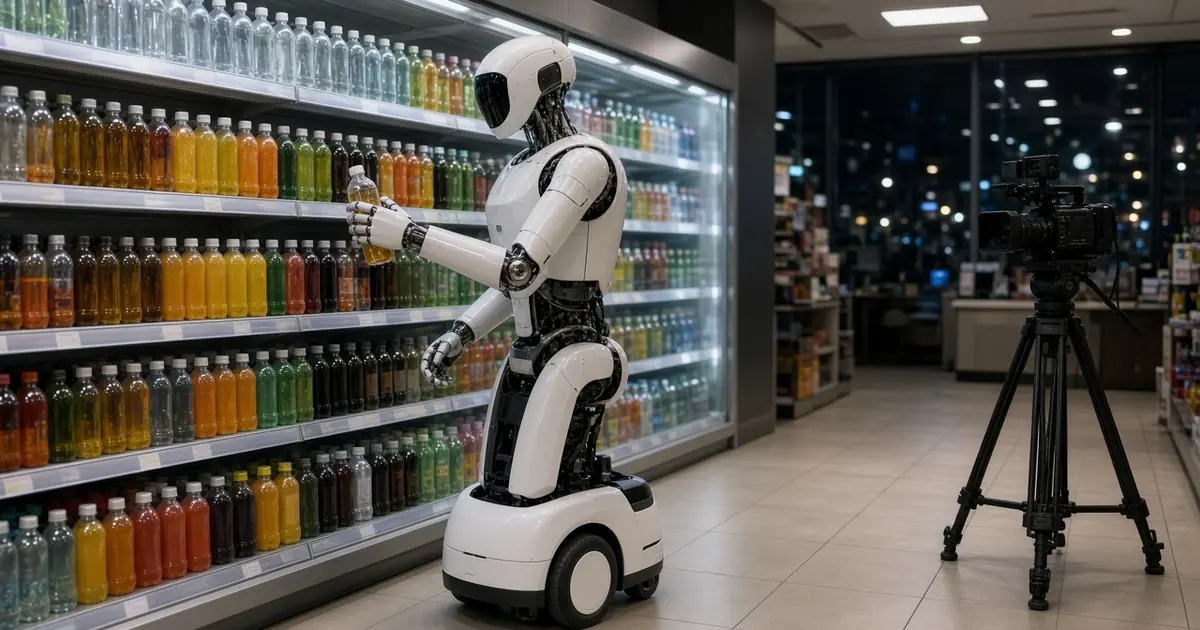
Chinese robotics developer AGIBOT staged a 24-hour convenience-store demonstration spanning November 2 and November 3, putting six G2 robots in a setting designed to resemble a demanding retail shift. The company called the event “Robots Never Clock Out.” Humanoids Daily reported that the broadcast began at 10 a.m. China time on November 2 and was scheduled to end at 10 a.m. on November 3, equivalent to 02:00 UTC on each date.
The announced tasks were deliberately broader than the single pick-and-place motions common in robotics clips. AGIBOT planned to show the robots stocking shelves, making coffee, preparing hot food, greeting customers and removing rubbish. It described the machines as store trainees encountering rush-hour traffic, overnight duty and the breakfast period. Those are different operational conditions, with changing human activity and demands on the robots’ hands, navigation and task planning.
A convenience store is a revealing choice of environment. Unlike a structured assembly station, a shop contains customers who move unpredictably, products that vary in size and packaging, and tasks that may be interrupted. A machine must avoid collisions, preserve food-handling hygiene, identify the correct item and return to unfinished work after a disruption. A robot that can make coffee in isolation may still struggle to do so while other machines and people share the counter.
A full-day livestream provides more context than a polished 20-second demonstration. Viewers can observe transitions between tasks and the physical space over time. But the length of a broadcast should not be confused with each robot working autonomously for 24 consecutive hours. The published description does not provide a verified per-robot duty cycle, human-assistance log, charging record or count of completed orders. Six robots sharing a shift could rotate through duties and maintenance periods.
That missing information is central to the economics. A retailer evaluating such a system would compare the number of orders or stocking tasks completed, time per task, breakage, customer wait times and safety incidents against an existing operation. It would also ask how many employees must supervise the machines. A deployment that replaces one repetitive task but requires constant specialist oversight could still be valuable as research, yet fall short of an immediate labor-saving proposition.
The food-preparation elements raise additional issues. Preparing hot food requires temperature and handling safeguards beyond those needed to move boxed goods. Coffee preparation involves liquids, heat and cleanup. The demonstration’s task list is evidence of what AGIBOT intended to test, not certification that the system satisfies food-safety rules or can be left unsupervised in a commercial store.
The G2 challenge also shows how robotics marketing is changing. Developers increasingly seek to prove endurance, multitasking and interaction in a recognizable workplace rather than just athletic motion. The store format allows AGIBOT to present many robot capabilities in a single event, while also creating an opportunity for outsiders to ask whether the same capabilities would persist during unplanned interruptions.
For a meaningful independent assessment, AGIBOT could publish an event log showing each robot’s active minutes, tasks attempted, successful completions, remote interventions, charging periods and safety stops. Video archives alone may not reveal every off-camera intervention. Such a report would convert a promotional demonstration into a benchmark that other vendors and prospective customers could compare.
The November event is a substantive attempt to test multiple humanoids in a shared service environment. Its strongest verified fact is the six-robot, 24-hour public challenge and the work categories announced. Claims about continuous autonomous retail operation require additional evidence that the broadcast description does not yet supply.