Trending Research
Why UCLA's PhoneBot, a small humanoid run by a smartphone, is getting attention
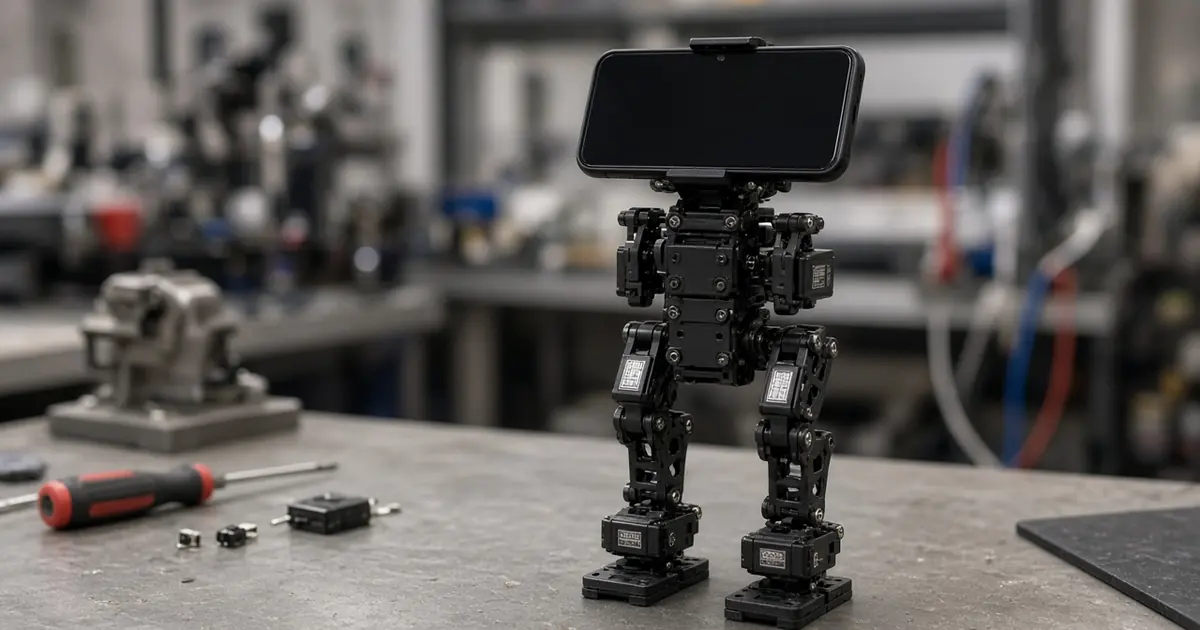
Short answer: PhoneBot is a small open-source humanoid from UCLA's Robotics and Mechanisms Laboratory (RoMeLa) that uses an ordinary Android smartphone as its camera, balance sensor, screen and main computer. The researchers estimate its parts cost at about $400 excluding the phone, according to their arXiv preprint and New Atlas, and the project was among X's trending robotics stories on 23 October 2026.
According to the paper, the robot is 48.3 cm tall, weighs 1.8 kg including the phone, and uses 13 low-cost servo motors: six in each leg plus one that turns the torso. The phone is not wired to the body; it sends joint commands over Wi-Fi to a small onboard computer that drives the motors, which the authors say makes it easier to swap in different phones.
The walking controller was trained in simulation with reinforcement learning, and the team reports demonstrations of walking, following a person using the phone's camera, and standing up from a face-down position. The researchers say they tested the app on four Android phones, including a 2017 Honor 9 and three prepaid models costing about $50 to $80, and that camera-based mapping did not run on the Honor 9. Speech recognition and the language model currently run on a nearby laptop rather than on the robot, the paper says.
The authors also list limitations: PhoneBot has no arms, its walking was trained only for flat ground, and its small motors limit what it can carry. The design files and code are open source and aimed at education and research, according to the project. For another example of low-cost humanoid research, see our report on Berkeley's SuperMimic controller trained on one GPU.