Research
Alibaba's Amap team releases λ0, a humanoid model trained largely on human video
Short answer: A team from Alibaba Group's Amap mapping business and its Token Hub unit has released λ0 (lambda zero), a model for controlling a humanoid robot's whole body that learns much of what it knows from first-person video of people. In a preprint on arXiv, the team reports that λ0 succeeded in 62.5% of real-world trials across four tasks on a Unitree G1 robot, compared with 40% for π0.5, the strongest rival it tested. The results have not been peer reviewed or reproduced by outside groups.
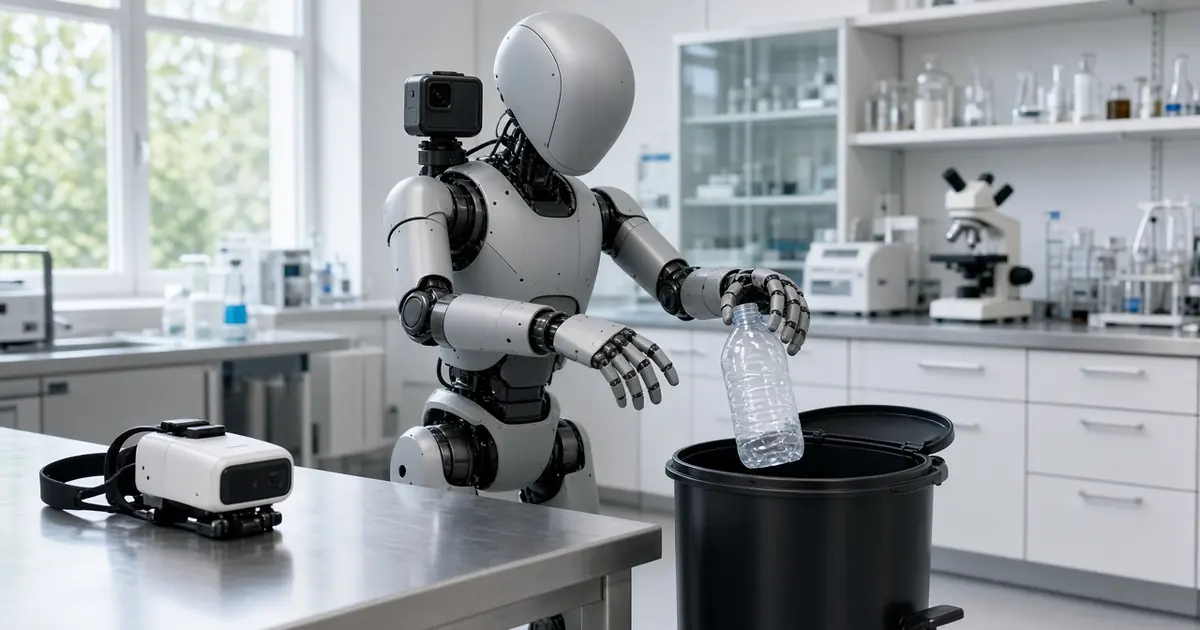
According to the paper, the key ingredient is HumanVerse, a 500-hour dataset of people doing everyday tasks while wearing a GoPro camera at a height matching the robot's own camera, with wearable trackers recording their body movement and hand motion reconstructed from the video. The team trains λ0 in stages, using HumanVerse in a middle stage before final tuning on robot demonstrations. The authors estimate human capture is roughly 3.4 times faster than collecting robot data, TSN reported.
The real-world tests covered four tasks with ten trials each, run by the authors on a Unitree G1 fitted with dexterous hands. The authors report that skipping the HumanVerse stage cut real-world success to 22.5%, which they present as the main evidence that the human data matters. They also report 90% success on the SIMPLE simulation benchmark, but note that this figure picks the best configuration per task and should not be read as a fixed-configuration comparison.
The code is available on GitHub under the Apache 2.0 licence, and TSN reported on 24 October that a mid-training checkpoint has been published on Hugging Face, while the HumanVerse dataset and the full final training and deployment workflows have not yet been released. The work comes as other companies, including Figure with its Index video programme, also bet on human video to train robots.