Research
Amazon-led team teaches a humanoid to hold boxes against its torso and under its arm
Short answer: Researchers from Amazon, the University of California, San Diego and the University of Michigan have published Whole-Body Dexterity (WBD), a method that lets a humanoid robot use its arms and torso, not just its hands, to hold and move objects. In real-world tests on a Unitree G1, the authors report that their controller completed 45 of 50 trials (90%), compared with 18% for direct motion retargeting and 4% for a general-purpose whole-body controller.
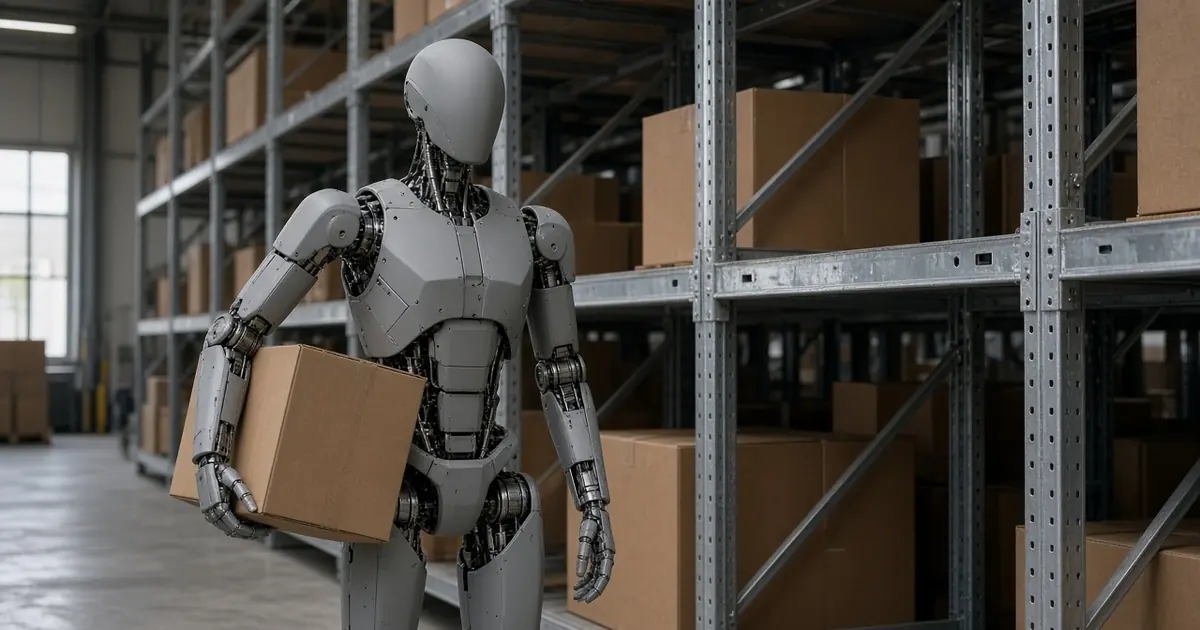
According to the arXiv preprint, the team first generated about 2.5 million simulated grasps that use the arms and torso, trained reinforcement-learning "experts" to move objects between those grasps, then distilled them into a single controller that needs only the robot's own joint readings and the object's rough dimensions. On the real robot, the tasks were moving a basketball or a 15 cm cardboard box to the shoulder or under one arm and back, plus a longer sequence of picking a box from a shelf, tucking it under an arm, walking it to a table and setting it down.
The robot was not acting on its own. The paper says every real-world trial was run by a single skilled human teleoperator wearing a motion-capture suit, with the WBD controller adjusting the arm commands to keep the object supported. In the shelf task, the controller finished all five stages in 7 of 10 trials and occasionally dropped the box, the authors report. The work is a preprint on arXiv.
Latest Robot News covered the paper on 25 October. The authors list the project site as wholebodydex.com. Other recent G1 research includes ETH Zürich's contact-planning policy.