Research
ETH Zürich's ACP policy lets a Unitree G1 climb ladders, vault and get back up after falls
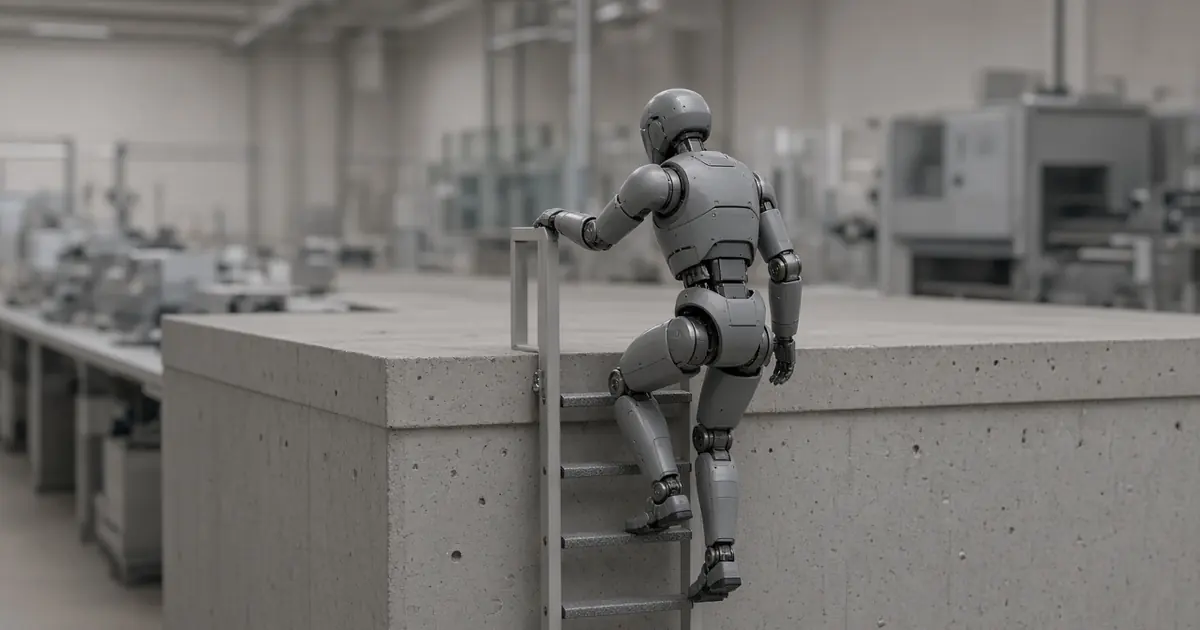
Short answer: A team led by ETH Zürich's Robotic Systems Lab has shown a Unitree G1 humanoid climbing ladders, vaulting obstacles and getting back up after falls using one learned control policy, according to Humanoids Daily. The method, called Attention-based Contact Planning (ACP), decides where parts of the robot's body should touch the environment and lets a second network work out the movement in between.
According to the outlet, the planner uses a height map built from a head-mounted LiDAR, the robot's own sensed state and a target position to predict contact points up to 1.5 seconds ahead for nine body parts: the hands, elbows, knees, feet and pelvis. A second network turns those targets into commands for 23 joints, and both run on the robot at 50 Hz without replaying a pre-recorded motion. The team trained the system with 13.2 minutes of human motion data plus reinforcement learning, Humanoids Daily reported.
The researchers report 92.5% average success across eight simulated obstacle courses, compared with 58.8% for a motion-generation-and-tracking baseline. Humanoids Daily stresses that this is a simulation figure, measured with sensor noise and physics randomisation switched off, and not a real-world success rate. The project also publishes failure and recovery clips, including a fall caused by mapping errors.
The paper, titled Humanoid Mobility via Attention-based Contacts, was submitted to arXiv on 22 October and is listed as under review, according to the outlet, which says the project credits ETH Zürich, Apple, the ETH AI Center and NVIDIA. The authors list limits including overhead contacts, hanging and manipulation. It is one of several recent G1 research projects, alongside Amazon's whole-body dexterity work and Alibaba's λ0 model.