Deployments
Robots take on Mount Tai's 3,100 stone steps: what the CMG challenge tested
Short answer: On Monday, 2 November 2026, nearly 90 teams took part in the CMG World Robot Mount Tai Challenge in Tai'an, Shandong Province, according to Euronews. Humanoid, quadruped and exoskeleton robots climbed a 3.9 km stretch of the mountain's ancient path, with about 3,100 stone steps and roughly 600 metres of elevation gain. According to AFP's report carried by CBS News, the fastest humanoid, from the Beijing-based team Zhishen Lingyue, finished a shorter humanoid course in 27 minutes and 26 seconds, while a four-legged robot from Beijing Lingyi Technology, a Unitree subsidiary, won the quadruped speed category in 43 minutes and 41 seconds.
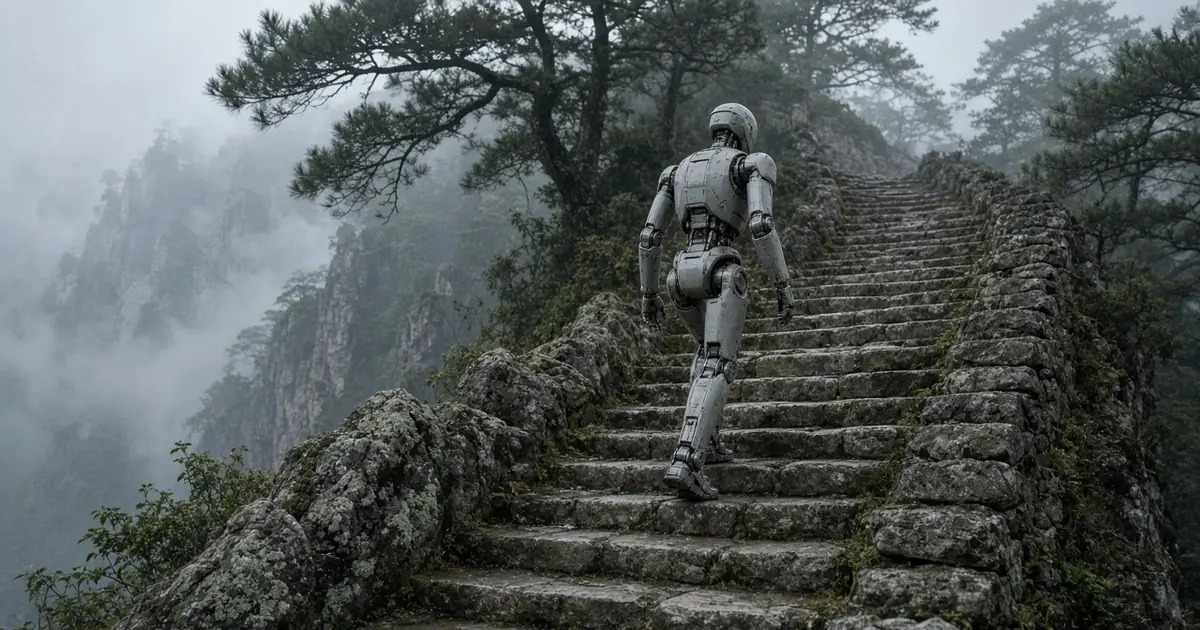
Mount Tai is one of China's best-known mountains, and its main walking route is a long staircase of uneven, worn stone. Euronews describes the course as a mix of steep slopes, long stairways and sharp bends. That is very different from the flat floors of a factory, a warehouse or a showroom, where most humanoid demonstrations take place.
The organisers framed the event as a real-world endurance test. Teams could enter in different ways, according to the AFP report: some tried to complete the route as fast as possible, while others had to carry fragile goods such as fresh eggs and watermelons to the summit. Euronews adds that some quadruped robots carried food supplies along the track. Local media quoted organisers calling the rocky terrain a natural extreme testing ground that could help prepare robots for real-world use.
For scale, CCTV said most tourists take at least two hours to walk the route, according to the AFP report. The winning quadruped's time of under 44 minutes on the full course is therefore well ahead of a typical hiker. The humanoid result is not directly comparable, because the fastest humanoid ran a shorter course than the full route, and the reports we reviewed do not give that course's exact length.
Why stairs are hard for humanoids. Walking up stone steps forces a two-legged robot to place each foot precisely on surfaces that vary in height, depth and grip, while keeping its centre of mass over a small support area. Any slip has to be caught within a fraction of a second. Steps that are chipped, sloped or wet add uncertainty the robot's sensors and controller must handle continuously. A long climb also strains batteries and joint motors, which heat up under sustained load, so a course like this tests endurance as well as balance.
Four-legged robots have a natural advantage here. With more feet on the ground at once, they are statically more stable, and their lower bodies make falls less damaging. That helps explain why the quadruped category could run the full route while the fastest humanoid result came on a shorter course.
Who took part. According to Euronews, the field covered three kinds of machines: humanoids, quadrupeds and exoskeletons, the wearable frames that assist a human walker. The reports we reviewed name only the two category winners mentioned above; they do not list full results, finishing rates or how much human help each robot received. Engineers walked alongside the machines, according to the AFP coverage, which is normal practice for safety at events like this.
What the event shows and what it does not. Public challenges like this give a rare look at how robots behave outside controlled labs, and the stair-climbing format is a clear, easy-to-understand test. But a single race does not show how often a robot completes such a course, how much remote control or intervention was used, or whether the same machines could do useful work at the top. Those details were not published in the reports we reviewed, so the results are best read as a demonstration rather than a benchmark.
For more on the companies involved in this sector, see our Unitree hub.