Deployments
Xiaomi Puts Two Humanoids Through an Eight-Hour Auto-Parts Sorting Trial
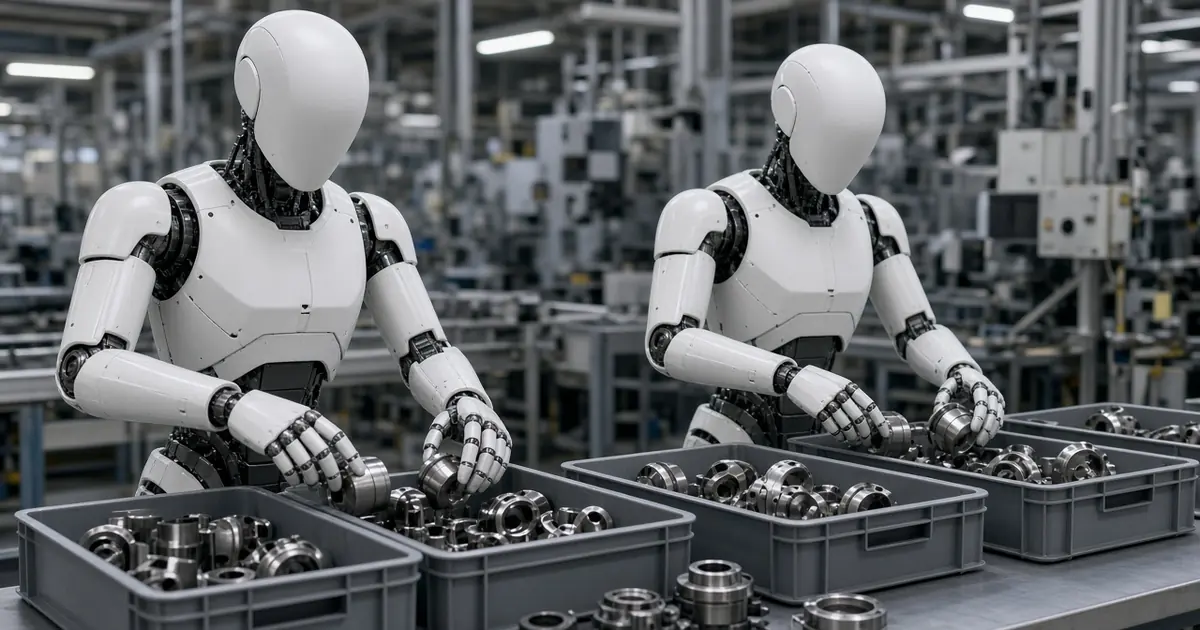
Xiaomi has released a November 3 video showing two humanoid robots sorting center-console side covers at its automotive factory. The company describes the exercise as an eight-hour task, a more demanding test of continuity than a short promotional clip of a robot lifting a single component. The robots are shown moving parts between mobile containers and upright racks with individual slots, according to Humanoids Daily’s account of the company footage.
The distinction between performing a movement and completing a factory assignment matters. A sorting station requires a machine to recognize which component belongs where, pick it without damaging the surface, position it correctly, and avoid disrupting the flow of parts to downstream assembly. The physical surroundings also matter: the robots are not operating on an empty stage but beside racks and carts resembling the equipment a human worker would encounter in a production area.
Xiaomi says the system detects and corrects anomalies autonomously and coordinates with its production-line systems. Those are company claims, not independently established performance measurements. The published material does not specify what counted as an anomaly, how many incidents occurred, or whether an operator had to intervene during the run. The video uses accelerated playback, including labels for five-times and 100-times speed, and a cumulative working-time counter. Such presentation can show task variety and continuity without documenting every minute of an entire shift.
This is not Xiaomi’s first attempt to put humanoid technology near vehicle manufacturing. In March, the company reported a 90.2% success rate during a three-hour autonomous pilot involving simultaneous installation of self-tapping nuts on both sides of an assembly, while meeting a 76-second production-cycle requirement. That result concerns a different operation; it cannot be carried over as the accuracy rate for the November side-cover exercise. In April, Xiaomi also showed CyberOne V2 interacting with visitors and distributing gift bags at an investor event, a setting with different safety and reliability demands.
The latest trial therefore advances one specific claim: Xiaomi is testing whether its robots can repeat a comparatively narrow parts-handling routine over a working-shift-length period. It does not yet establish that the robots outperform a fixed industrial arm, cost less than a conventional sorting station, or can transfer without retraining to a different vehicle component. Those are separate questions for a purchasing manager considering a deployment.
A factory operator would want to know the number of covers processed per hour, the fraction placed correctly on the first attempt, the time spent recovering from mistakes, and the extent of human supervision. Battery information is another gap. Eight hours of elapsed activity is not evidence of eight hours on a single charge; the company has not disclosed whether charging breaks or battery swaps were involved.
The commercial opportunity is nonetheless intelligible. Automotive factories handle many parts whose shapes, packaging and delivery schedules change across models. A mobile, general-purpose robot might eventually be redeployed among several such stations rather than engineered for one fixed task. That flexibility has economic value only if changeovers, error rates and maintenance remain manageable.
Xiaomi’s November footage is best read as a demonstration of sustained task testing, not proof of a fully staffed-out robotic production line. The next consequential update would be an independently auditable shift report: actual throughput, intervention counts and uptime, compared with the existing human or automated process. Until then, the company has shown a promising application and identified precisely the measurements it still needs to publish.